Key Takeaways
- Industrial drainage systems are tailored for complex requirements, ensuring effective water and wastewater management.
- Traditional drainage relies on conventional methods, suitable for simpler residential applications with lower demands.
- A well-planned drainage system solution enhances operational efficiency and maintenance access in industrial facilities.
- Choosing the right drainage approach depends on site conditions, facility type, and expected water flow requirements.
- Industrial drainage systems are tailored to site-specific requirements for effective water management.
Triranga Infra Projects Pvt. Ltd. is a leading provider of industrial drainage solutions. Choosing the right drainage approach can make a major difference in how efficiently water, wastewater, and surface runoff are managed across an industrial facility. A modern Drainage System Solution is designed around site requirements, load conditions, flow management, and long-term usability, while traditional drainage generally relies on simpler, conventional arrangements.
What Is an Industrial Drainage System?
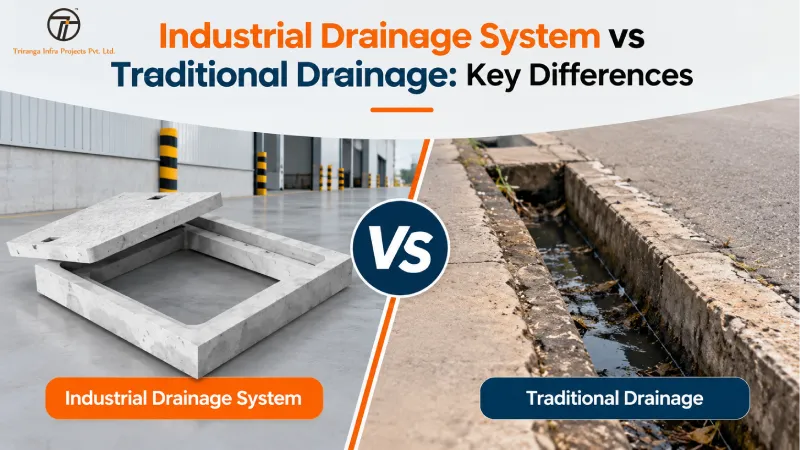
An industrial drainage system is planned to manage water and wastewater generated across manufacturing units, warehouses, processing areas, commercial facilities, and other industrial spaces.
These systems can be designed according to the layout of the site, expected water flow, access requirements, and the type of area being drained. The main focus is to create a practical drainage setup that matches the operational needs of the facility.
At Triranga Infra Projects Pvt. Ltd., we work with drainage requirements that need careful planning rather than a one-size-fits-all approach. Our focus is on developing a suitable Drainage System Solution based on the application and site conditions.
What Is Traditional Drainage?
Traditional drainage commonly refers to conventional methods used to collect and move excess water from a property or facility. Depending on the application, these systems may include basic channels, open drains, conventional pipelines, or other established drainage arrangements.
Such systems can be suitable for straightforward drainage requirements where the water flow, site layout, and maintenance needs are relatively simple. However, industrial facilities may have more demanding operating conditions that require a more carefully designed solution.
The difference is often not about old versus new, but about whether the drainage design is appropriate for the environment in which it will operate.
Industrial Drainage vs Traditional Drainage: Key Differences
When comparing both approaches, it is useful to look at the factors that directly affect daily operation and maintenance.
| Comparison Factor | Industrial Drainage System | Traditional Drainage |
|---|---|---|
| Design approach | Planned according to industrial site requirements | Generally follows conventional layouts |
| Flow management | Designed for specific drainage conditions | More suitable for simpler drainage needs |
| Application | Industrial, commercial, manufacturing and large facilities | Common in basic residential or general applications |
| Maintenance access | Can be planned around operational requirements | May depend on conventional construction |
| Site integration | Designed to suit facility layout and working areas | Often uses standard drainage arrangements |
| Long-term suitability | Focuses on application-specific performance | Depends strongly on site conditions and design |
This comparison shows why industrial drainage needs should be evaluated based on actual operating requirements rather than only initial installation considerations.
Design and Flow Management
Industrial sites can have multiple drainage points, different working zones, heavy movement areas, and varying water-flow requirements. Because of this, drainage planning needs to consider how water travels across the facility.
A properly planned Drainage System Solution can be structured around collection points, drainage paths, outlet locations, and the overall site layout. This approach helps create a system that works with the facility instead of simply adding drainage wherever space is available.
Traditional drainage can work effectively for uncomplicated layouts, but a conventional arrangement may not always be the most suitable option for a complex industrial environment.
Durability and Operational Requirements
Industrial drainage systems may operate in areas exposed to regular traffic, equipment movement, water accumulation, and demanding working conditions. The drainage design therefore needs to be considered alongside the conditions of the site.
Our approach at Triranga Infra Projects Pvt. Ltd. focuses on understanding where drainage is required and how the system will function within the facility. A well-matched drainage design should support the operational environment without creating unnecessary complications for surrounding activities.
Traditional systems can also be durable when correctly designed and maintained. Their suitability depends on the application, construction quality, materials, and environmental conditions.
Maintenance and Accessibility
Drainage involves not just the movement of water from an area but the maintenance of the drainage system itself.
In drainage systems of industries, it would be good to incorporate in the design the cleaning, accessibility, inspection, and even future maintenance of the drainage system.
There will certainly be differences between traditional drainage and its maintenance based on whether the drainage is exposed, enclosed, underground, or connected with other drainage systems.
Therefore, in order to come up with a good Drainage System Solution, it is necessary to take into account not just the installation but also future maintenance of the system.
Which Drainage System Is More Suitable for Industrial Facilities?
There is no single drainage method that is right for every site. The better option depends on the facility, drainage requirements, site conditions, and expected water flow.
An industrial system may be more appropriate when the project involves:
- Large manufacturing or processing areas
- Multiple drainage zones
- Complex site layouts
- Areas with regular equipment or vehicle movement
- Specific requirements for water collection and discharge
Traditional drainage may remain suitable for simpler applications where the site does not require specialized drainage planning.
The right choice should be based on the actual needs of the facility rather than using the same drainage method for every project.
What to Check Before Selecting a Drainage System
Before finalizing a drainage arrangement, buyers and project teams should review the following points:
- Type and size of the facility
- Expected water and wastewater flow
- Areas where drainage is required
- Site layout and available drainage paths
- Accessibility for cleaning and maintenance
- Traffic and load conditions around drainage areas
- Material and construction requirements
- Future operational needs of the facility
These checks can help buyers define the project requirements more clearly and select a drainage approach that fits the application.
Why Choose Us
Triranga Infra Projects Pvt. Ltd. focuses on practical drainage requirements for industrial and infrastructure applications. We understand that different facilities may require different drainage arrangements based on their layout, usage, and operating environment. Our team works with customers to identify suitable requirements and provide a dependable Drainage System Solution for the intended application. We focus on functionality, practical planning, and solutions aligned with project needs rather than relying on a standard approach for every site.
Conclusion
Both industrial drainage and traditional drainage have their uses, depending on the case. While traditional drainage is quite effective for simple needs, industrial drainage tends to be designed with a bit more thought in terms of the building plan, flow, operations, and accessibility. Identifying the Drainage System Solution begins with analyzing the property and its drainage needs. With proper planning, companies will find a way to install drainage that meets their needs and suits the building better.
Looking for a suitable industrial drainage solution for your project? Connect with Triranga Infra Projects Pvt. Ltd. to discuss your requirements and select the right drainage approach for your facility.
Call: +91 9974125431
Email: info@trirangainfra.com